You just finished a great discovery call. The client loves your style, the budget sounds right, and you can already picture the final shots. But here is the trap: excitement often kills clarity. Without a written agreement that spells out exactly what you will do-and what you won’t-you are setting yourself up for scope creep, late payments, and arguments over who owns the images.
A photography proposal is a document that outlines the creative vision, scope of work, deliverables, and pricing for a project before any money changes hands or cameras click. It serves two masters at once. First, it is a sales tool designed to win the job by showing you understand the client’s business goals. Second, it acts as a quasi-technical statement of work that protects you from doing free labor later on. When you get this document right, you stop trading time for money and start selling outcomes.
The Core Structure of a Winning Proposal
Many photographers treat proposals like invoices with extra steps. They list gear, hours, and rates, then send it off. This misses the point. Clients rarely care about how many hours you spend shooting; they care about the cost of the photos they need for their website or ad campaign. Your proposal needs to bridge the gap between your artistic process and their business results.
A strong proposal follows a narrative arc rather than a dry checklist. Start by proving you listened. Include a section dedicated to client understanding. Summarize their brand mission, their target audience, and the specific problem they need solved. Use the "know-feel-do" framework: what do you want the viewer to know, feel, and do after seeing these images? When you articulate this upfront, you position yourself as a strategic partner, not just a technician with a lens.
Next, present your creative approach. Don't just say "I will take pictures." Describe the mood, the lighting style, and the story beats. If you discussed specific concepts during the call-like falling coffee beans for a cafe brand or candid laughter for a corporate retreat-write them down here. Show, don't just tell. Embed links to portfolio pieces or case studies that mirror this specific vibe. This builds confidence that you can execute the vision you just described.
Defining the Scope of Work to Prevent Creep
This is where most freelancers bleed revenue. Scope of work is the detailed boundary of services included in the agreed fee, specifying locations, duration, crew, and production tasks. Vague language like "full day coverage" or "as needed editing" invites disaster. You must define limits using hard numbers.
Break the scope down into concrete categories:
- Duration and Schedule: Specify exact hours. Instead of "one day," write "One production day of up to 8 hours, including setup and breakdown." Define overtime rates explicitly (e.g., $150 per hour after the 8th hour).
- Locations and Sets: List the number of locations. "One studio session and two on-site outdoor locations" is clear. If location scouting is required, state whether it is included or billed separately.
- Crew and Responsibilities: Who provides the models? Who books the makeup artist? Clarify if you are bringing an assistant or if the client handles logistics. Misalignment here causes delays on shoot day.
- Pre-production: Does the price include concept development, mood boards, or wardrobe consultations? If yes, limit the scope. "Up to two rounds of creative planning calls" prevents endless back-and-forth emails.
- Post-production Limits: Define what "editing" means. Is it basic color correction only? Or does it include heavy retouching? Specify the maximum number of revisions included. "Two rounds of minor adjustments included; additional retouching billed at $75/hour."
By quantifying every aspect of the workflow, you remove ambiguity. When a client asks for a third location or ten extra headshots, you can point to the proposal and say, "That falls outside our agreed scope. I’d be happy to add it for an additional fee." This isn't being difficult; it's being professional.
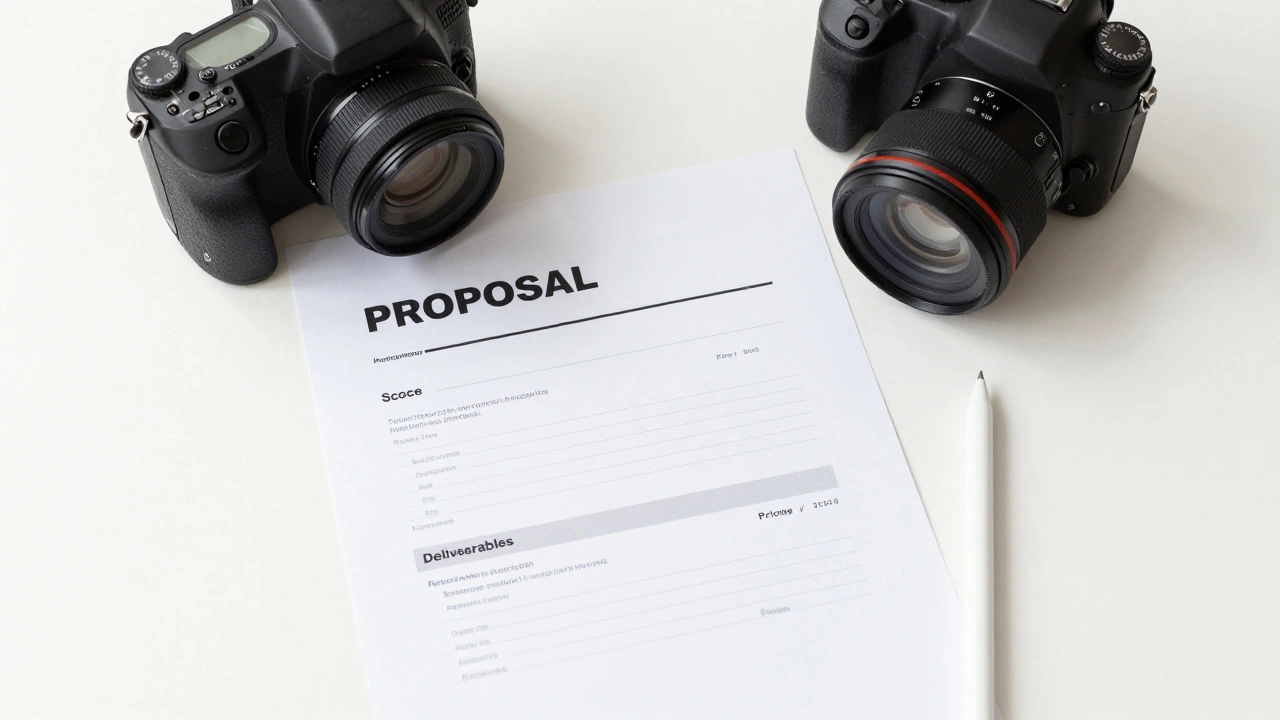
Deliverables: Quantity, Format, and Timeline
Deliverables are the physical or digital assets the client receives. This section must be precise because it directly ties to your pricing. Never promise "all photos." That phrase is a liability nightmare. Instead, specify the exact output.
| Attribute | Example Specification | Why It Matters |
|---|---|---|
| Quantity | 20 fully retouched high-res images | Prevents clients from expecting hundreds of edited files. |
| Format | JPEG (300 dpi) for print; Web-optimized JPEGs | Ensures technical compatibility for the client's use case. |
| Delivery Method | Private online gallery via Pixieset or Dropbox link | Simplifies download and sharing for non-technical clients. |
| Turnaround Time | Proofs within 7 days; Finals within 14 days of selection | Manages expectations and allows you to batch-edit efficiently. |
| Raw Files | Not included (available for purchase at $5/image) | Protects your intellectual property and standard of quality. |
Note the distinction between proofs and finals. Many photographers offer a proof gallery first, allowing the client to select their favorites. Only those selected images undergo full retouching. This saves you hours of work on shots the client doesn't want and gives them agency in the process. Always clarify that RAW files remain your property unless a separate buyout is negotiated. Handing over unedited RAWs exposes you to criticism if someone edits them poorly and blames your original capture.
Pricing Strategy: Value Over Hours
How you present your price signals how you view your own worth. Hourly rates cap your income and punish efficiency. If you get faster and better, you make less money. Instead, price by value and deliverables. If a client needs ten hero images for a homepage redesign that drives sales, charge for the impact of those images, not the three hours it took to shoot them.
Structure your pricing into simple packages. Avoid complex line-item breakdowns that invite à la carte bargaining. When you list "Camera rental: $50, Assistant: $100, Editing: $200," the client starts negotiating each line. Instead, offer tiered options:
- Basic Package: 10 edited images, web-ready, 1-day shoot. Perfect for social media updates.
- Standard Package: 25 edited images, print-ready + web, 1-day shoot, includes model release. Ideal for website refreshes.
- Premium Package: 50 edited images, multiple setups, extended licensing, priority turnaround. Best for major ad campaigns.
This "Goldilocks" effect often pushes clients toward the middle option. It also simplifies their decision-making. They aren't buying your time; they are buying a solution to their content problem. Make sure the pricing section is clean, bold, and easy to read. Hide the math behind the scenes.
Licensing and Usage Rights
This is the most misunderstood part of photography contracts, yet it is critical for long-term revenue. Image licensing is the legal permission granted to a client to use photographs for specific purposes, durations, and territories. Just because a client pays for the photos doesn't mean they own the copyright. You retain the copyright; they buy the right to use the images.
Explain this in plain English within the proposal. Many clients assume they can put the photos on billboards, t-shirts, and international ads forever. If your base price covers only one-year domestic web use, state that clearly. Offer upgrades for broader rights. "Extended commercial license for global print and digital use: +$2,000." Educating clients early prevents awkward conversations six months later when they want to use your work in a new campaign.
Also, reserve your right to use the images for your own portfolio, social media, and award submissions. Unless the project is under a strict Non-Disclosure Agreement (NDA), you should always keep the ability to showcase your best work. This clause adds value to your personal brand without costing the client anything.
Terms, Conditions, and Acceptance
The final section turns your proposal into a binding agreement. Include payment terms: typically a 50% retainer to book the date, with the balance due upon delivery or before the shoot. Specify cancellation policies. What happens if the client cancels 24 hours before the shoot? The retainer should be non-refundable to cover your lost opportunity cost.
Add a signature block. Whether digital via PandaDoc or HoneyBook, or printed, getting a signature transforms the document from a suggestion into a contract. It psychologically commits the client and provides legal recourse if things go south. Keep the tone friendly but firm. You are protecting both parties by ensuring everyone knows exactly what they signed up for.
Should I give clients all the RAW files?
Generally, no. RAW files are unprocessed data, not final products. Handing them over risks your reputation if the client edits them poorly. Most professional photographers retain ownership of RAWs. If a client insists, charge a significant licensing fee (often equal to the shoot fee) to compensate for the loss of exclusivity and potential misuse.
How do I handle scope creep during the project?
Refer back to the signed proposal. If a request falls outside the defined scope (e.g., an extra location or additional retouching), provide a quick change order with the additional cost. Get approval before doing the work. Clear boundaries in the initial proposal make this conversation much easier.
Is it better to charge hourly or by the project?
For most commercial and portrait work, charging by the project or package is superior. It aligns your pay with the value delivered to the client, not your speed. Hourly rates are best reserved for open-ended assignments where the scope cannot be defined in advance, such as some event coverage.
What if the client wants to use the photos for merchandise?
Merchandise falls under "merchandising rights," which is a high-value license. Standard web or print licenses usually exclude this. You should negotiate a separate, higher fee for merchandising usage, as the client is generating direct revenue from your art.
Do I need a separate contract if I have a proposal?
If your proposal includes all essential terms (scope, price, payment, liability, copyright, and signatures) and is signed by both parties, it legally functions as a contract. However, many photographers attach a standard master service agreement (MSA) to the proposal for added legal protection and clarity.