Ever watched a high school volleyball match and wondered why the photographer is crouched behind the bleachers, pointing a flash unit at the ceiling? Or seen a wrestling tournament with lights flickering like a disco and thought, is that even legal? It’s not magic. It’s flash-and it’s governed by strict rules, physics, and safety concerns you probably never knew existed.
Why Flash Is Even Needed Indoors
Indoor sports arenas aren’t lit like your living room. Even the brightest LED high-bay lights can leave shadows, uneven color, and motion blur when capturing fast-moving athletes. Natural light? Gone. Window access? Rare. That’s where flash steps in-not as a supplement, but as a necessity. Professional sports photographers rely on strobe systems to freeze motion, render accurate skin tones, and eliminate the grainy, noisy look you get from high ISO settings alone.But here’s the catch: you can’t just plug in a speedlight and start shooting. Indoor venues have lighting specs that go far beyond "make it bright." For example, the vertical illumination-the light hitting the athletes from above-must be at least half the horizontal illumination. In top-tier events, it’s equal. Why? Because if the light only comes from the sides, athletes look flat. Their movements lose depth. The ball becomes a blur. And broadcasters? They can’t use the footage.
The Rules You Can’t Ignore
Before you bring a flash into any indoor sports venue, you need permission. Not a nod. Not a "sure, go ahead." Written permission. Many leagues, from youth tournaments to college and pro events, have official policies. Why? Two big reasons: safety and fairness.First, direct flash in an athlete’s eyes can cause momentary blindness. Imagine a volleyball setter tracking a spike-and a strobe goes off right in front of them. That split-second disorientation can lead to a missed block, a bad landing, or worse. That’s not just a photo issue. It’s a liability issue. Venues have insurance policies that specifically ban unapproved strobes for this exact reason.
Second, flash can interfere with broadcast cameras. If your flash triggers a radio sync system meant for professional gear, it can cause a cascade of unintended flashes from other photographers’ equipment. Suddenly, the whole arena is blinking. Broadcasters lose control of exposure. Slow-motion replays turn into strobe effects. It’s chaos.
How Flash Power Works in Real-World Settings
You might think a standard 600-watt second speedlight is enough. It’s not. In a gym with 30-foot ceilings, that light gets swallowed. What professionals use? High-power studio strobes-often 1,000 to 2,000 watt seconds-mounted on stands or rigged to bleacher railings. These aren’t handheld. They’re fixed. And they’re not firing at 1/1000th of a second like a camera shutter. They’re firing at 1/2000th or faster to freeze a 60 mph volleyball spike.But here’s the trick: you don’t point them at the court. You bounce them off the ceiling. Why? Because bouncing creates a massive, soft light source that covers the whole playing area. It’s like turning the entire ceiling into a giant softbox. That’s why photographers climb bleachers or use boom rigs. They’re not trying to light a single player. They’re lighting the whole zone where the action happens.
And the color? It matters. You need a CRI (Color Rendering Index) of 90 or higher. If the light is too blue or too yellow, skin tones look wrong. Jerseys lose their true color. Broadcast systems reject footage. That’s why pro setups use daylight-balanced bulbs-5600K-and avoid cheap, low-CRI LEDs.
Sport-Specific Flash Techniques
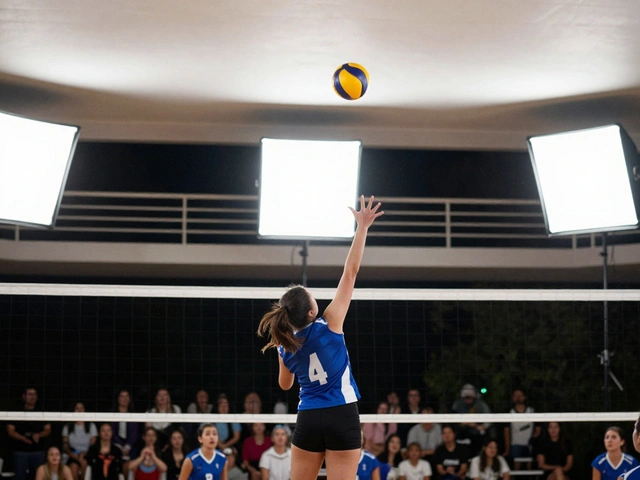
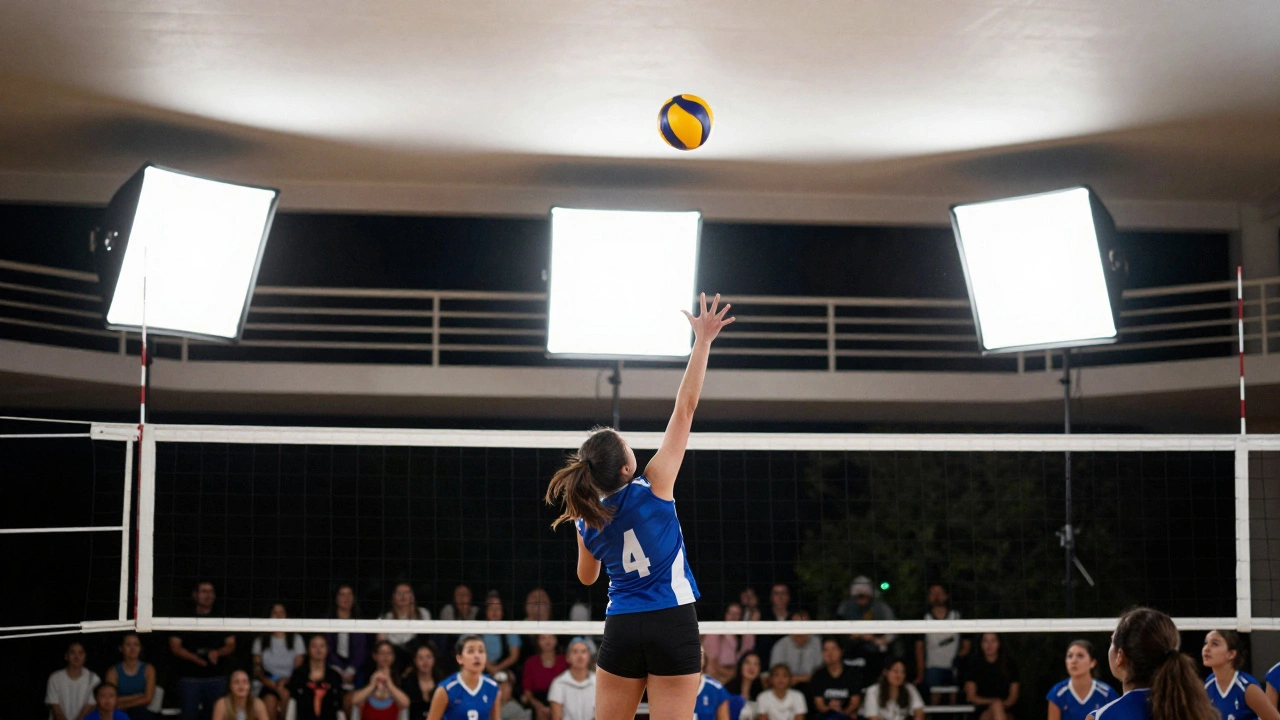
Not every sport treats flash the same way.Volleyball: The gold standard for flash control. Players are constantly looking up, tracking the ball. Direct flash? Disaster. The only safe method is ceiling bounce. Flash units are placed at the corners of the court, elevated, and angled upward. Reflectors are used to widen the light spread. Some pros even use white foam panels taped to the ceiling to diffuse the light further. The goal? Make the light look like it’s coming from everywhere-not from a single point.
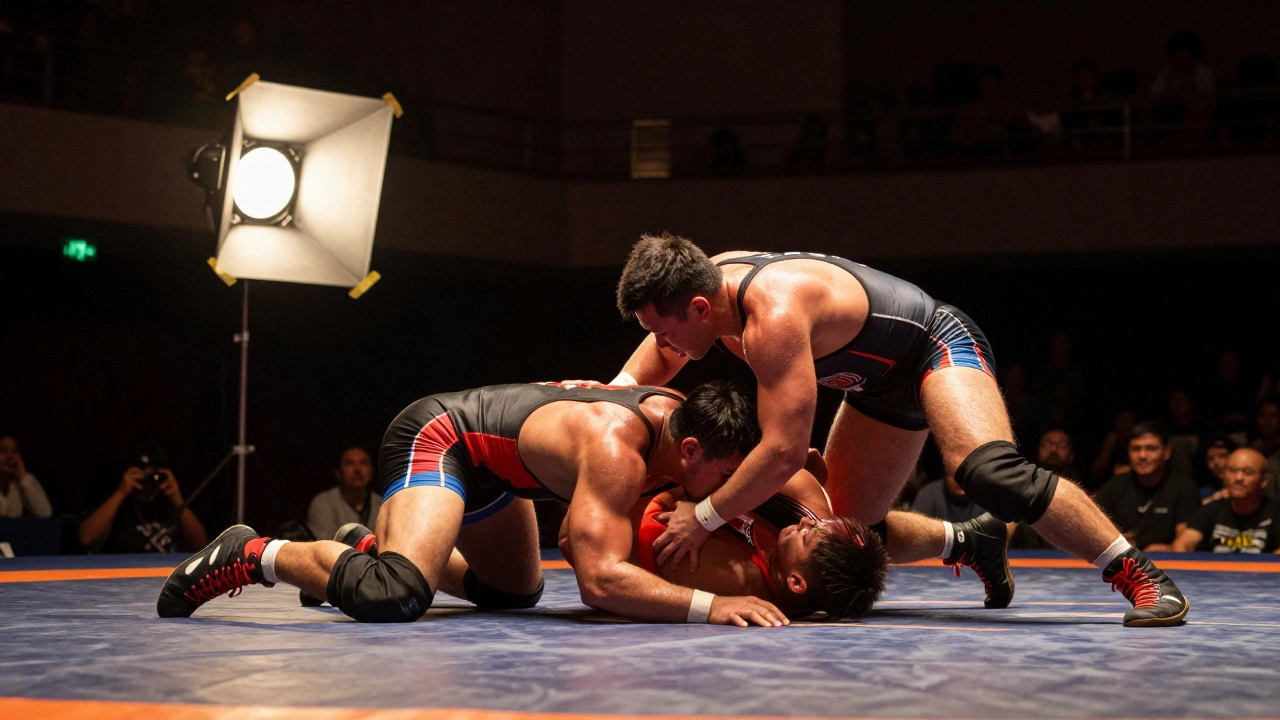
Wrestling: Less strict. Wrestlers are focused on the mat, not the crowd. Photographers can use lower-angle flash with a warm fill. A trick? Tape a strip of manila folder behind the reflector. It adds a touch of warmth to shadows without being obvious. You can even use a single flash on a low stand, aimed at the mat’s center. No need for ceiling bounce here.
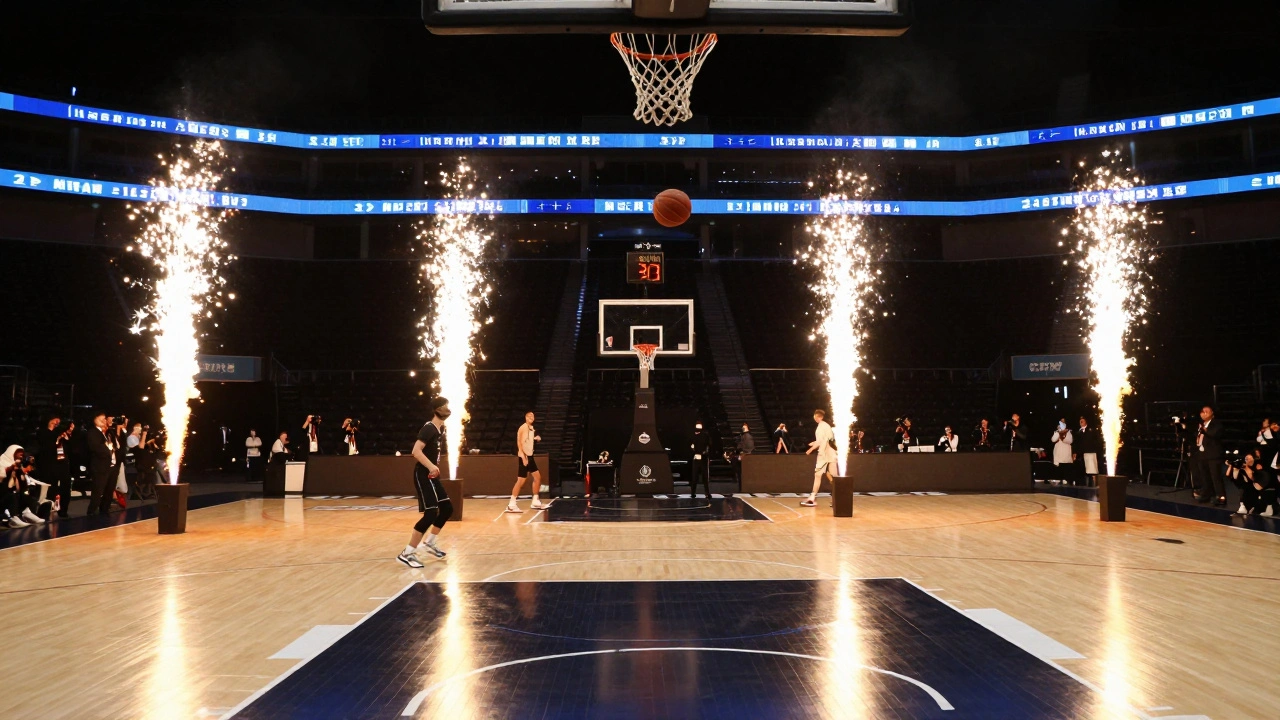
Basketball: Tricky. The court is huge. You need multiple flashes-often four or more-arranged around the baseline and sidelines. Each is synced via radio triggers. You avoid the hoop area to prevent glare on the backboard. And you never shoot from behind the basket. The ball’s shadow will ruin your shot.
Synchronization: The Hidden Cost of Professional Flash
If you’re using one flash? A sync cord works. Cheap. Simple. But if you’re using two or more? Forget cords. They tangle. They break. They’re a nightmare in a packed gym.Professional setups use radio triggers. Each flash has a receiver. The camera has a transmitter. When you press the shutter, the signal goes wirelessly. No delays. No misfires. But here’s the catch: radio systems cost $300-$800 per unit. Add in three flashes? You’re looking at $1,500 minimum just for the sync gear. And that’s before buying the lights.
Why not use optical slaves? Because spectators have cameras too. A fan’s phone flash can trigger your gear. Suddenly, your entire setup fires when someone takes a picture. That’s why radio sync isn’t optional-it’s mandatory for any serious indoor sports shoot.
What Happens When Flash Meets Broadcast
If a game is being televised, everything changes. Broadcast cameras need flicker-free lighting. That means your flash can’t pulse at 50Hz or 60Hz. It has to fire in perfect sync with the camera’s frame rate. For slow-motion shots at 1,500 fps? The lighting system must be stable at 1/1500th of a second. That’s not a consumer strobe. That’s a $10,000+ professional lighting array with constant output.Many venues now use hybrid systems: permanent LED panels for the broadcast feed, and portable strobes for still photographers. The two systems are timed so they don’t interfere. But that takes planning. And coordination. And often, a tech meeting the day before the event.
What Not to Do
Here are the mistakes people make-every time:- Using on-camera flash. It creates harsh shadows, washed-out colors, and blinds athletes.
- Placing flashes too low. You’ll light the floor, not the players.
- Ignoring CRI. A light that looks bright but renders color poorly is useless for sports.
- Not testing before the event. Flash behavior changes with ceiling height, color, and material. A white ceiling bounces differently than a gray one.
- Assuming "everyone does it." Venues change policies. Always get written approval.
Bottom Line: It’s Not Just About Light
Flash in indoor sports isn’t about making your photos look cool. It’s about making them accurate, safe, and usable. It’s physics. It’s regulation. It’s respect for the athletes and the event.If you’re serious about shooting indoor sports, forget the cheap gear. Learn the rules. Talk to the venue. Test your setup. And remember: the best flash is the one no one notices. The one that makes the action look natural, even though it’s lit by a dozen hidden strobes.
Can I use my camera’s built-in flash for indoor sports?
No. Built-in flashes are too weak, too direct, and too disruptive. They blind athletes, create harsh shadows, and often trigger unwanted flashes from other cameras. They’re designed for snapshots, not sports photography. Always use external strobes with bounce or diffusers.
Do I need permission to use flash at a high school game?
Yes. Most school districts and athletic associations require written permission before any strobe equipment is used. This is for safety and insurance reasons. Never assume it’s okay. Contact the coach or event organizer ahead of time.
What’s the best flash power for indoor sports?
For most indoor sports, 1000-2000 watt-seconds is ideal. Lower power won’t reach the ceiling or fill a large gym. Higher power is overkill unless you’re shooting in a massive arena. Always test at the venue-ceiling height and color affect how much light you actually need.
Why do some photographers bounce flash off the ceiling?
Bouncing creates a large, soft light source that mimics natural overhead lighting. It reduces harsh shadows, avoids blinding athletes, and evenly illuminates the entire playing area. It’s the most effective way to make flash look invisible while still delivering enough power.
Can I use LED lights instead of flash for indoor sports?
LEDs can work if they’re high-power (5000+ lumens), have a CRI above 90, and are mounted on tripods or stands. But they can’t freeze motion like a strobe can. For fast action like volleyball spikes or basketball dunks, strobes are still superior. LEDs are better for video or static shots.